TL;DR: Commercial water damage restoration follows the same IICRC S500 drying science as residential work, but the stakes are different: a closed office, restaurant, or warehouse means lost revenue, displaced tenants, and potential lease liability. The fastest way to limit downtime is calling a certified restoration crew before you call your contractor, extraction and structural drying must start within 24-48 hours to prevent secondary mold growth and keep your insurance claim clean.
Your sprinkler system triggered overnight. Or a supply line failed in the second-floor break room and soaked the open-plan office below. Or a slow roof drain backed up during a heavy Pacific storm and saturated 3,000 square feet of commercial carpet. Whatever happened, you’re now doing the math: how long will this take, what will insurance cover, and how do you keep your business running while it gets fixed? This post answers all three.
What makes commercial water damage different from a residential loss?
Commercial water damage is more complex than a flooded bathroom because the building systems, occupancy types, and financial stakes are all larger. A single loss can affect multiple tenants, trigger business interruption coverage, implicate OSHA worker-safety requirements, and involve building-code upgrades that weren’t required before the damage. Restoration crews working commercial jobs need to coordinate with property managers, tenants, insurers, and sometimes local code officials simultaneously, not just dry the building.
The physical differences matter too. Commercial buildings typically have:
- Concealed plenum spaces above drop ceilings that trap moisture and grow mold before anyone notices
- Slab-on-grade concrete floors under tile or carpet that hold moisture for weeks without aggressive drying
- Multi-zone HVAC systems that can distribute contaminated air or moisture to unaffected areas if not isolated
- High-density contents, server rooms, commercial kitchens, inventory, medical equipment, that need immediate contents restoration to avoid total loss
In Oxnard’s industrial corridor near the Port of Hueneme, warehouse and cold-storage facilities add another layer: temperature-controlled environments where a water intrusion can compromise both the building and the product inventory stored inside. In Camarillo, office parks and agricultural processing facilities face similar complexity, large floor plates, high ceilings, and mixed-use occupancy that slows drying if not addressed with commercial-scale equipment.
How does commercial water damage restoration actually work?
The process follows the IICRC S500 Standard for Professional Water Damage Restoration, the industry benchmark for both residential and commercial losses. The phases are the same; the equipment and coordination are scaled up.
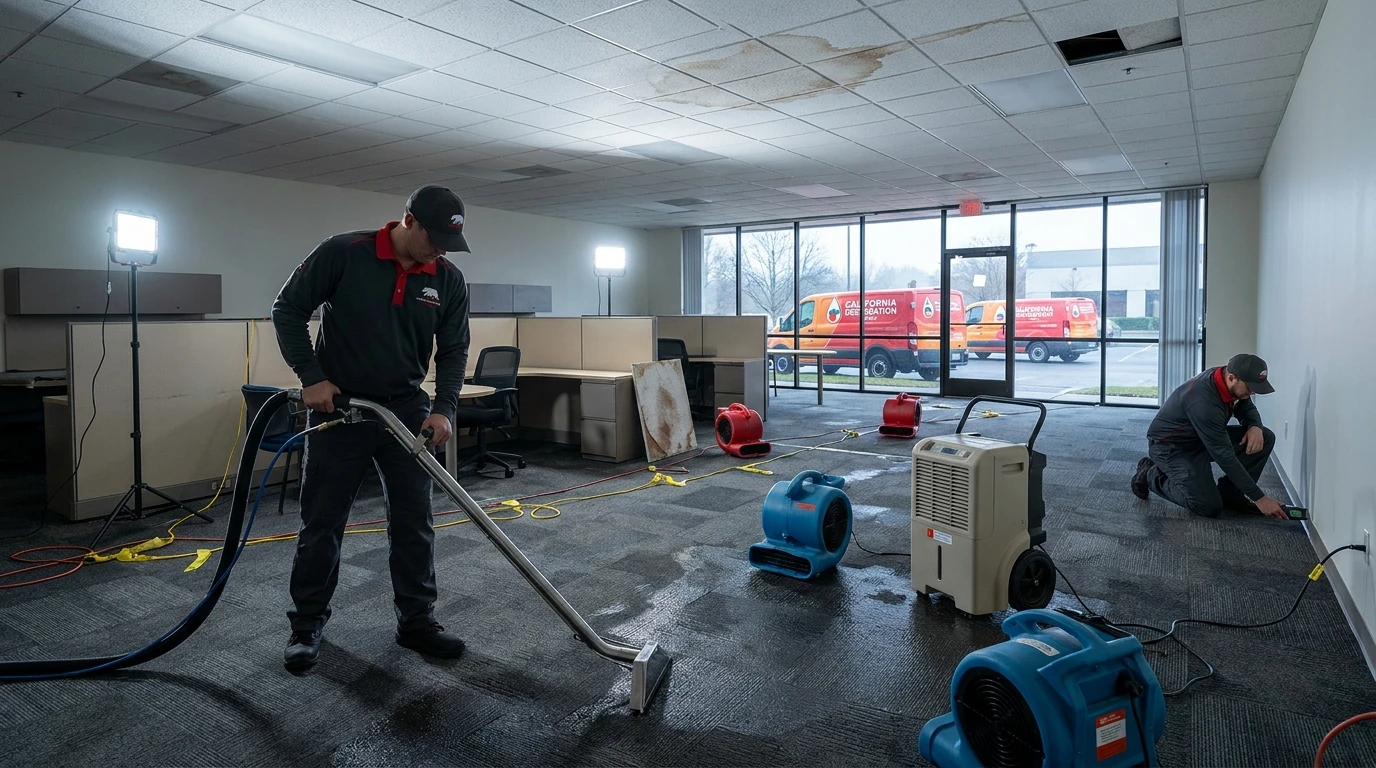
1. Emergency extraction (hours 1-6) The crew arrives, assesses the water category (clean water from a supply line is Category 1; gray water from an appliance or HVAC drain is Category 2; sewage or floodwater is Category 3, also called black water), and begins extraction immediately. Commercial jobs often require truck-mounted extractors pulling 200+ gallons per hour, not portable units.
2. Moisture mapping (hours 1-12) Technicians use thermal imaging cameras and calibrated moisture meters to map the full extent of saturation, including walls, ceilings, subfloor, and any concealed cavities. This documentation is critical for your insurance adjuster and for proving the drying job was complete.
3. Structural drying (days 1-5, sometimes longer) Low-grain refrigerant (LGR) dehumidifiers and high-velocity air movers are placed according to a drying plan. Commercial losses often require 20-50 pieces of equipment running continuously. Daily moisture readings track progress against the drying goal, typically returning materials to their pre-loss moisture content (usually 12-16% for wood framing, per IICRC S500 guidelines).
4. Controlled demolition, if needed Wet drywall, saturated insulation, and soaked flooring that cannot be dried in place are removed. This is called “flood cuts”, horizontal cuts in drywall typically 12-24 inches above the waterline to expose framing and allow airflow. Removing unsalvageable material is faster and cheaper than trying to dry it in place and discovering mold three weeks later.
5. Clearance and documentation Before reconstruction begins, the restoration company provides a drying log, moisture readings at clearance, and a written scope of work. This package is what your insurance adjuster needs to close the mitigation claim and authorize reconstruction.
OSHA’s flood cleanup guidance also applies to commercial restoration sites, workers re-entering a water-damaged commercial space may be exposed to electrical hazards, contaminated water, or compromised structural elements. A certified restoration crew handles the hazard assessment before your employees re-enter.
How do you limit business interruption during restoration?
The goal is to shrink the overlap between “restoration in progress” and “business closed.” Several strategies work in practice:
Phased drying. If only part of the building is affected, a good restoration crew will isolate the wet zone with poly-sheeting containment barriers and restore unaffected areas to normal occupancy quickly. A Camarillo office park that loses one suite to a burst pipe doesn’t need to close the whole building, but that requires a crew that maps the damage accurately on day one, not one that erects containment everywhere to be safe.
After-hours equipment runs. Air movers and dehumidifiers are loud. For retail, hospitality, or medical offices, scheduling equipment placement during off-hours and running the drying cycle overnight reduces the impact on daily operations.
Contents pack-out and storage. For offices, restaurants, or retail spaces with high-value contents, professional contents restoration, packing out furniture, electronics, and inventory to a climate-controlled facility, clears the floor for faster drying and protects assets that would otherwise sit in a damp environment for days. This is often covered under the same commercial property claim.
Early adjuster coordination. The single biggest cause of extended downtime on commercial losses isn’t the drying, it’s the insurance approval gap. A restoration company that documents the loss thoroughly from hour one (photos, moisture maps, drying logs, written scope) gives your adjuster everything they need to authorize work without back-and-forth. Ask your restoration crew specifically: “What documentation will you provide for my adjuster?”
What does commercial water damage restoration cost, and what does insurance cover?
Commercial water damage restoration typically costs between $5,000 and $75,000+ depending on the square footage affected, the water category, the materials involved, and how quickly the response started. A 2,000-square-foot office suite with Category 1 water and no mold might run $8,000-$18,000 for mitigation. A Category 2 or 3 loss in a larger facility with contaminated water, saturated concrete, and contents pack-out can exceed $50,000 before reconstruction begins.
Most commercial property insurance policies cover sudden and accidental water damage, a burst pipe, a failed appliance line, a roof drain backup during a storm. They generally exclude:
- Gradual leaks or maintenance failures the owner knew about
- Flood damage from surface water (requires separate NFIP or private flood coverage)
- Mold remediation if the mold resulted from a delayed response
Business interruption coverage is a separate endorsement. It typically kicks in after a waiting period (often 72 hours) and covers lost revenue and extra expenses while the property is being restored. The key: business interruption claims require documentation of the loss timeline. A certified restoration company’s drying logs and scope of work become the supporting evidence for that claim.
For apartment buildings and multi-family properties in Oxnard or Ventura, the loss can trigger both the building owner’s commercial policy and individual tenant renters’ insurance claims simultaneously. A restoration crew experienced in commercial losses knows how to document for multiple parties without creating conflicting records.
For a detailed look at what water damage restoration costs in Ventura County across residential and commercial losses, see our water damage restoration cost guide.
What should you do in the first hour after a commercial water loss?
The actions in the first 60 minutes determine whether you’re looking at a $12,000 mitigation job or a $60,000 remediation-plus-reconstruction project.
- Stop the source. Shut off the water supply valve to the affected area or call your building’s maintenance line. If the source is unclear or involves electrical panels, call 911 before entering.
- Call a certified restoration company. Not a general contractor, not a carpet cleaner. A company with IICRC Water Restoration Technician (WRT) and Applied Structural Drying (ASD) certifications has the training and equipment to dry the building correctly. California Restoration West holds both.
- Notify your insurer. Call your commercial property insurer to open a claim. You don’t need to wait for a damage assessment, opening the claim starts the clock on business interruption coverage and authorizes the restoration company to begin work.
- Document before cleanup starts. Walk the affected area and photograph everything before extraction begins. This is your pre-mitigation record.
- Restrict access. Keep employees out of the wet area until the restoration crew has assessed for electrical hazards and water category. Category 2 and 3 water contains contaminants that require PPE, your staff shouldn’t be walking through it.
For a step-by-step response guide that applies to both residential and commercial losses, the burst pipe emergency checklist covers the first 24 hours in detail.
California Restoration West responds 24/7 to commercial water damage calls across Ventura County, including Oxnard, Camarillo, Thousand Oaks, and Simi Valley. Their crews hold IICRC WRT, ASD, and IICRC Certified Firm status and are OSHA trained for commercial job-site safety. Request a commercial water damage assessment at (805) 290-7292.
About California Restoration West
California Restoration West is an IICRC Certified Firm serving Ventura, Oxnard, Camarillo, Thousand Oaks, and surrounding Ventura County communities. Licensed, insured, and OSHA trained, their team holds IICRC certifications in Water Restoration (WRT), Applied Structural Drying (ASD), and Applied Microbial Remediation (AMRT). They handle water damage restoration, mold remediation, storm damage restoration, contents restoration, crawl space encapsulation, and water cleanup for both residential and commercial properties. Available 24/7 at (805) 290-7292.