
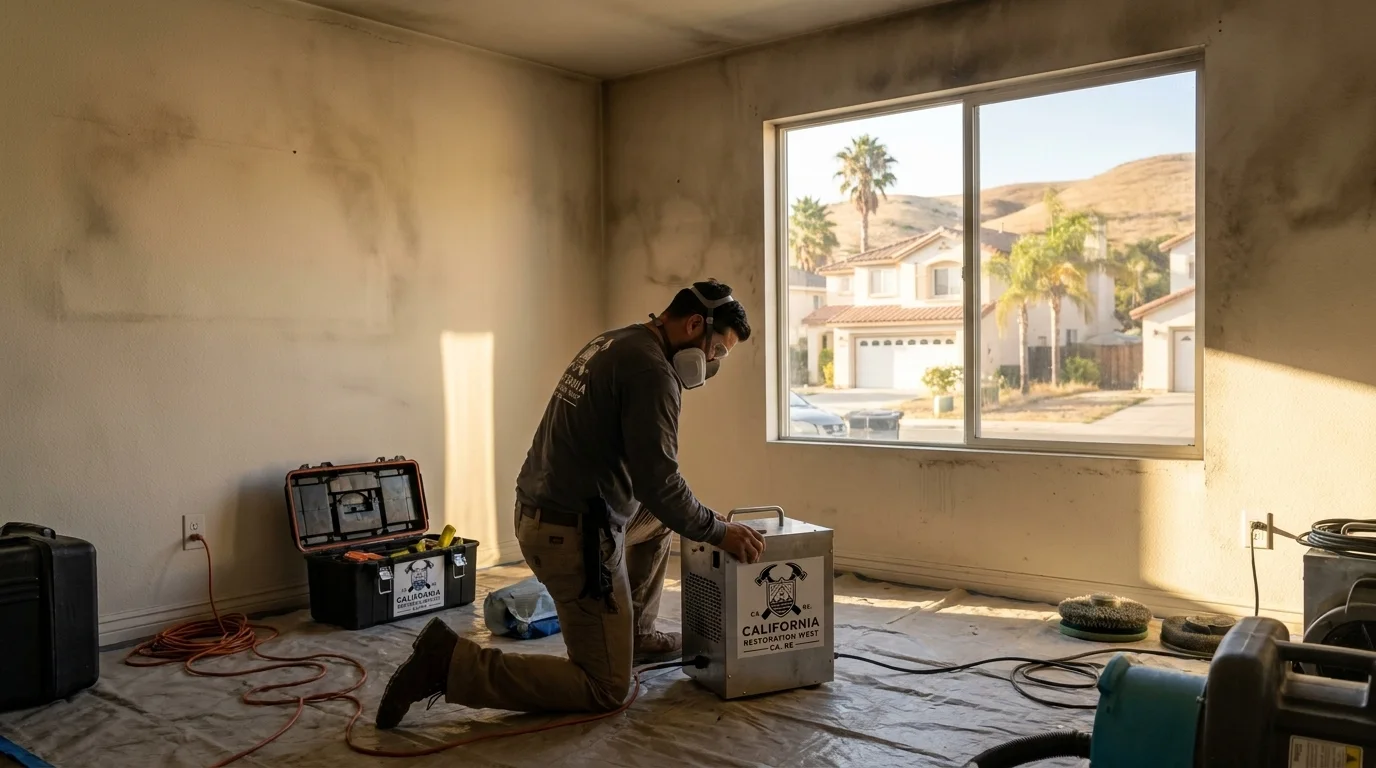
Odor Removal and Deodorization in San Buenaventura (Ventura)
24/7 odor removal and deodorization in San Buenaventura (Ventura), CA. IICRC-certified, insurance billing accepted. Call (805) 290-7292.
Our IICRC-certified technicians are dispatched from our Ventura, CA headquarters and are typically on-site in San Buenaventura (Ventura) within 60 minutes of your call.
Ventura sits where the Santa Ana winds funnel through the Transverse Ranges and push dry, superheated air straight into the coastal plain, and that same wind pattern that makes wildfire smoke travel so far inland also drives odor molecules deep into porous surfaces before a homeowner even realizes the smell has settled in. Whether the source is a kitchen fire in a 1960s ranch-style home near the Westside, wildfire ash from a hillside evacuation, or a sewage backup in an older craftsman near Midtown, persistent odors in Ventura properties require more than ventilation and candles. California Restoration West is based here in Ventura and responds around the clock.
Why Ventura Properties Hold Odors Longer Than You’d Expect
Ventura’s coastal humidity is deceptive. Mornings often bring marine layer moisture that soaks into wood framing, stucco, and insulation, and when a smoke or sewage event follows, those already-damp materials act like a sponge. The city’s housing stock includes a large share of homes built between the 1940s and 1980s, many with original plaster walls, hardwood subfloors, and minimal vapor barriers. Plaster is particularly absorptive: odor compounds bind to its calcium-based matrix in a way that surface sprays cannot reach. Stucco exteriors common throughout Ventura can trap smoke particulate in their textured finish, meaning the smell that seems to come from inside is sometimes radiating back from the outside walls.
The Santa Ana wind events that roll through the county in fall and early winter are a specific local factor. During a Santa Ana, smoke from regional wildfires enters homes through gaps in window seals, attic vents, and HVAC returns at elevated concentrations. That pressurized infiltration pushes odor-laden particles further into wall cavities than a typical indoor fire would.
Our Deodorization Process, Calibrated for Ventura Conditions
Effective odor removal is not a single treatment. The process starts with source identification: finding and removing any remaining contaminated material, whether that is charred drywall, saturated insulation, or a soiled subfloor. Skipping this step means deodorizing around the problem rather than solving it.
Once the source is addressed, the treatment method is matched to the structure and the odor type:
- Thermal fogging vaporizes a deodorizing solution into a dry fog that penetrates the same pathways smoke traveled, reaching inside wall cavities and HVAC ductwork.
- Hydroxyl generation uses UV-light-driven chemistry to break odor molecules apart at the molecular level without requiring the space to be vacated, which matters for occupied rentals or businesses.
- Ozone treatment is highly effective for severe smoke or biological odors but requires the space to be unoccupied during treatment and properly cleared afterward. Given Ventura’s mix of multi-unit properties and older single-family homes, we assess occupancy and ventilation before selecting this method.
- HEPA air scrubbing runs continuously during and after treatment to capture particulate that deodorizing agents dislodge.
All drying and structural work follows IICRC standards, and the team holds IICRC AMRT and WRT certifications alongside OSHA training.
Equipment and Methods for Older Ventura Homes
Ventura’s pre-1980 construction presents specific equipment decisions. Older forced-air systems with metal ductwork can harbor smoke residue that re-contaminates a treated space every time the furnace or AC runs. We inspect and treat duct interiors as part of any smoke or fire odor job rather than treating it as an add-on. Original hardwood floors common in Midtown and Westside bungalows absorb odors into the wood grain itself; in moderate cases, hydroxyl treatment and surface sealing are sufficient, but in severe cases the subfloor needs to be evaluated for replacement before any finish floor goes back down.
Stucco exteriors are treated with a low-pressure odor-counteractant application on the affected elevations, not just the interior surfaces, because the textured finish traps soot particles that will off-gas back into the home through open windows.
Local Note
Ventura homes near the hillside neighborhoods above Highway 33 and in the areas closest to the Ventura River bottom tend to have crawl spaces that stay damp year-round due to the water table and coastal soil conditions. When a sewage or flood event introduces odor into one of these homes, the crawl space almost always needs separate treatment: the combination of existing moisture and new contamination creates conditions where odor compounds and microbial growth reinforce each other. Treating only the living space and leaving the crawl space unaddressed is one of the most common reasons a deodorization job appears to fail within a few weeks.
If your property falls anywhere in the 93001 through 93004 ZIP range and you are dealing with a recurring smell that returns after cleaning, the crawl space or subfloor is the first place worth investigating.
Persistent odors in a Ventura property rarely resolve on their own, especially once marine layer moisture has had time to reactivate whatever is embedded in the walls or flooring. Call California Restoration West at (805) 290-7292 any time, day or night, and we will assess the source, match the right deodorization method to your structure, and document everything your insurance carrier needs to process the claim.
Serving San Buenaventura (Ventura) from our Ventura headquarters — ★ 5.0 · 9 Google reviews
“Jimmy and his team were great to work with — professional, responsive, and did excellent work here in the Thousand Oaks/Conejo Valley area. Highly recommend them for anyone looking for reliable, quality service.” — Davis, November 2025Read our reviews on Google →
Odor Removal and Deodorization in San Buenaventura (Ventura): Service Coverage
Frequently Asked Questions
How fast can you arrive for odor removal and deodorization in San Buenaventura (Ventura)?
How does Ventura's marine layer affect how long smoke odor lingers in a home?
Are older Ventura homes in areas like Midtown or the Westside harder to deodorize than newer construction?
Does wildfire smoke from Santa Ana wind events require different treatment than a kitchen or structure fire?
Why does a deodorization job sometimes seem to work at first but the smell returns a few weeks later in Ventura properties?
Will my homeowner's insurance cover professional odor removal after a fire or sewage event in Ventura?
Odor Removal and Deodorization response in San Buenaventura (Ventura)
Most San Buenaventura (Ventura) calls see a technician on-site within 60 minutes from our Ventura headquarters.
Nearby & Related
- Odor Removal and Deodorization in Ventura
- Restoration Services in San Buenaventura (Ventura)
- Mold Remediation in San Buenaventura (Ventura)
- 24/7 Emergency Water Damage Restoration in San Buenaventura (Ventura)
- Odor Removal and Deodorization in Camarillo
- Odor Removal and Deodorization in Carpinteria
- Contact California Restoration West