24/7 Emergency Water Damage Restoration in Santa Rosa Valley
24/7 emergency water damage restoration in Santa Rosa Valley, CA. IICRC-certified, insurance billing accepted. Call (805) 290-7292.
Our IICRC-certified technicians are dispatched from our Ventura, CA headquarters and are typically on-site in Santa Rosa Valley within 60 minutes of your call.
Santa Rosa Valley sits in a narrow inland corridor where marine air funnels through the Conejo Grade and seasonal rains can arrive fast and heavy after long dry stretches. When that combination hits a property, the ground saturates quickly, drainage systems back up, and water finds its way into crawl spaces, slab seams, and wall cavities before most homeowners realize anything is wrong. California Restoration West responds to water damage calls in Santa Rosa Valley around the clock, bringing IICRC-certified technicians and professional drying equipment directly to your door.
Why Santa Rosa Valley Properties Are Vulnerable to Water Damage
The valley’s topography channels runoff toward low-lying lots during winter storms. Because the area developed largely through custom and semi-custom home construction on larger parcels, many properties have long runs of supply plumbing, irrigation systems that tie into the main line, and finished garages or bonus rooms built close to grade. Any of those details can turn a slow leak into a significant loss.
Soil composition in this part of Ventura County shifts between clay-heavy and sandy-loam profiles depending on where a parcel sits relative to the valley floor. Clay soils hold water against foundation walls rather than draining it away, which means a heavy rain event can create hydrostatic pressure that pushes moisture through block or poured-concrete foundations even when the roof and windows are perfectly intact. Homeowners sometimes notice efflorescence or a faint musty odor in a lower-level room weeks after a storm, not realizing the moisture intrusion started at the foundation.
Older supply lines in homes built during the valley’s earlier development phases are another consistent factor. Galvanized and early copper fittings corrode at joints over decades, and the pressure swings that come with seasonal temperature changes in an inland valley accelerate that wear. A fitting that holds through summer can fail during the first cold snap of November.
Our Water Damage Restoration Process in Santa Rosa Valley
When a call comes in, the first priority is stopping the source. If a supply line or appliance connection is the culprit, a technician will locate the shutoff and isolate the affected zone before any equipment is staged. From there, the process follows a structured sequence.
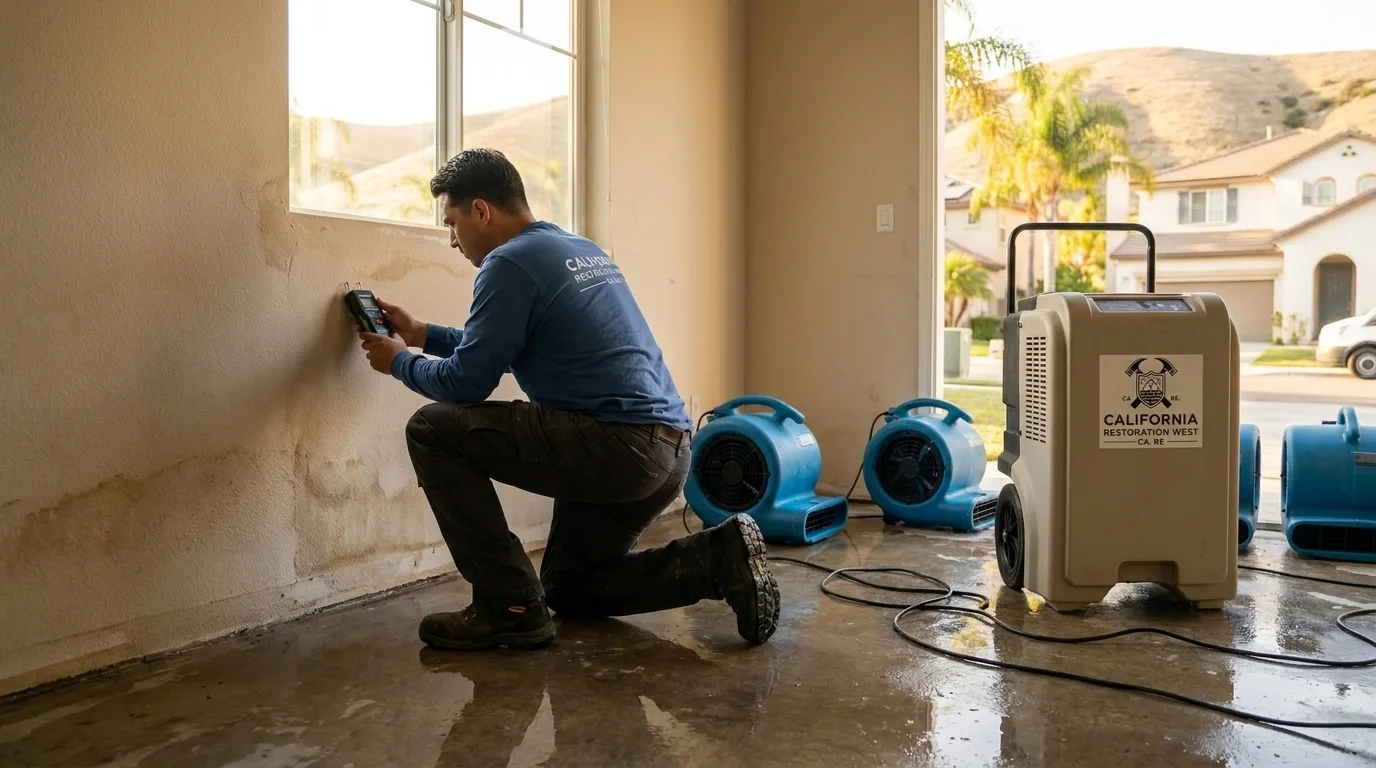
Inspection and moisture mapping. Thermal imaging and calibrated moisture meters establish where water has traveled, not just where it is visible. Water behind plaster or beneath hardwood reads dry at the surface while the substrate stays saturated, so this step drives every decision that follows.
Water extraction. Truck-mounted and portable extraction units remove standing water and pull moisture from carpet, pad, and subfloor materials. The goal is to reduce the water load before evaporation equipment is placed, which shortens total drying time significantly.
Structural drying. Industrial air movers and low-grain refrigerant dehumidifiers are positioned according to a drying plan calibrated to the room geometry, material types, and ambient conditions. In Santa Rosa Valley’s warmer inland climate, outdoor humidity levels during summer are often low enough to support aggressive drying targets, but that changes during winter storm systems when outdoor dew points rise. Equipment settings are adjusted daily based on psychrometric readings.
Monitoring and documentation. Moisture readings are logged at each visit. That data serves two purposes: it tells the crew when materials have reached drying goals, and it gives your insurance adjuster a verifiable record of the remediation scope.
Content and material decisions. Affected drywall, insulation, and flooring are evaluated against IICRC S500 standards. Materials that cannot be dried in place are removed, and the scope is documented photographically before any demolition begins.
Reaching Santa Rosa Valley from Ventura
California Restoration West is based in Ventura. The most direct route to Santa Rosa Valley runs east on the 101 to the 23 North, then into the valley via Moorpark Road or Tierra Rejada Road depending on the specific address. Under normal traffic conditions that corridor is manageable, and because the team operates 24/7, late-night and early-morning calls avoid the congestion that builds on the 101 and 23 during commute hours. If you are calling from the eastern side of the valley near the Moorpark border, routing from the 118 is sometimes faster.
Santa Rosa Valley Insurance Coordination
Most water damage claims in this area run through standard homeowners policies, though the coverage trigger matters. Sudden and accidental losses, a burst pipe, a failed appliance supply line, a roof leak from storm debris, are typically covered. Gradual seepage or maintenance-related failures often are not. The documentation collected during moisture mapping and drying is exactly what adjusters need to evaluate the claim, and the team can communicate directly with your carrier’s field adjuster or third-party desk to keep the process moving.
Local Note
In Santa Rosa Valley, many custom homes were built with finished subterranean spaces, wine cellars, lower-level media rooms, or utility areas that sit partially below grade. These spaces often have limited mechanical ventilation, which means drying equipment needs to work harder to move moisture-laden air out of the space. When the team sets up drying in one of these rooms, negative-pressure ventilation is frequently added to the plan alongside standard air movers, pulling humid air toward an exterior exhaust point rather than letting it recirculate. It is a small adjustment that makes a measurable difference in how quickly the space reaches drying goals.
If water is moving through your Santa Rosa Valley property right now, call California Restoration West at (805) 290-7292. The team is available at any hour, and the sooner extraction begins, the narrower the window for secondary damage.
Serving Santa Rosa Valley from our Ventura headquarters — ★ 5.0 · 9 Google reviews
“Excellent work! Lots of experience and professionalism!” — Adan, November 2025Read our reviews on Google →
Water Damage Restoration in Santa Rosa Valley: Service Coverage
Frequently Asked Questions
How fast can you arrive for water damage restoration in Santa Rosa Valley?
How quickly can California Restoration West reach a property in Santa Rosa Valley for a water emergency?
Does the clay-heavy soil common in parts of Santa Rosa Valley affect how water damage is assessed or dried?
Are the finished subterranean rooms common in Santa Rosa Valley custom homes harder to dry after a water loss?
What documentation will I have for my insurance claim after water damage in Santa Rosa Valley?
How long does structural drying typically take for a water loss in a Santa Rosa Valley home?
Water Damage Restoration response in Santa Rosa Valley
Most Santa Rosa Valley calls see a technician on-site within 60 minutes from our Ventura headquarters.
Nearby & Related
- 24/7 Emergency Water Damage Restoration in Ventura
- Restoration Services in Santa Rosa Valley
- Mold Remediation in Santa Rosa Valley
- 24/7 Emergency Storm Damage Restoration in Santa Rosa Valley
- 24/7 Emergency Water Damage Restoration in Camarillo
- 24/7 Emergency Water Damage Restoration in Carpinteria
- Contact California Restoration West