
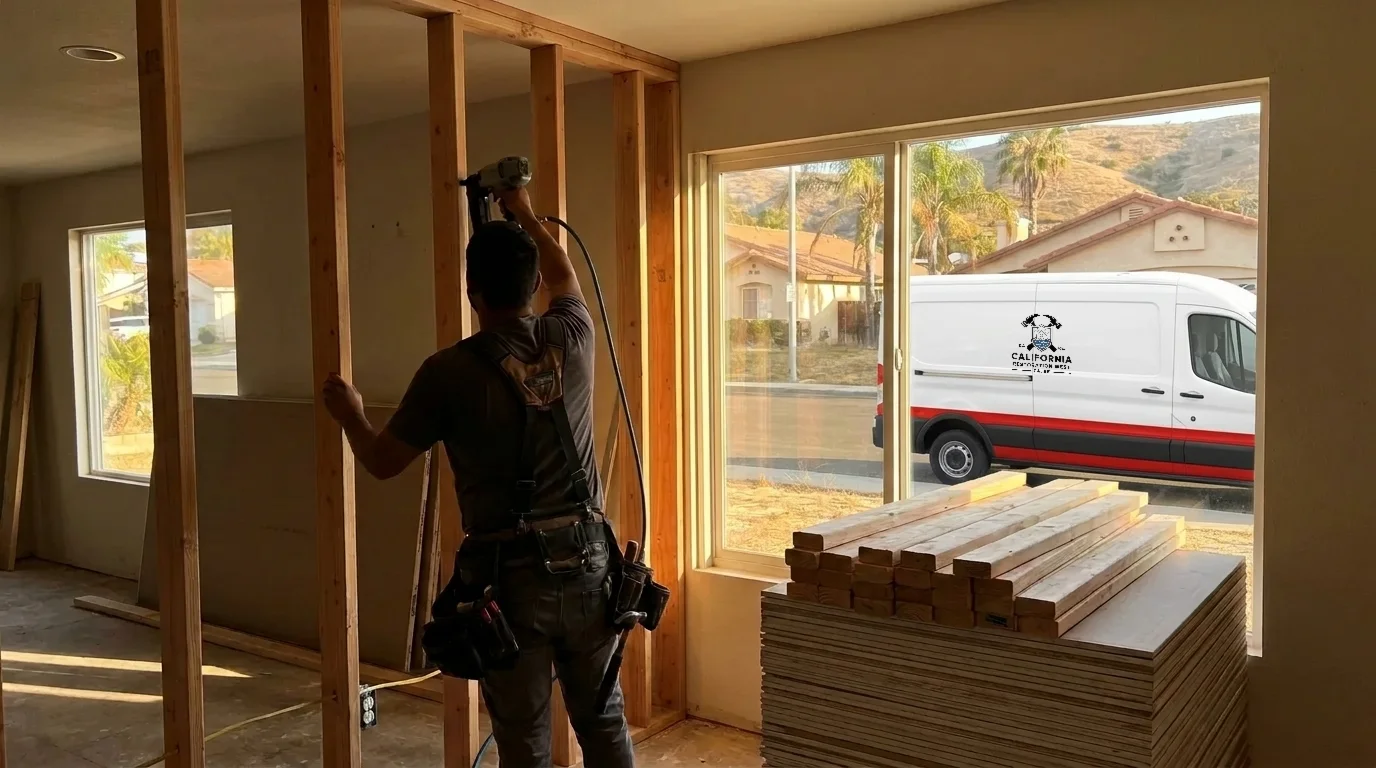
Reconstruction Services in Ventura
24/7 reconstruction services in Ventura and surrounding areas. IICRC-certified, insurance billing accepted. Call (805) 290-7292.
What reconstruction services actually involves
Once the water is extracted, the smoke odor is gone, or the demolition crew has pulled out everything that couldn’t be saved, a property is left with open stud bays, exposed subfloor, missing drywall, and sometimes a kitchen or bathroom that no longer has walls at all. Reconstruction is the build-back phase: framing, insulation, drywall, flooring, cabinetry, paint, trim, and in fire or structural cases, permitted structural repair to joists, headers, or load-bearing walls. For a single bathroom this might mean two to three weeks of work. For a fire-damaged kitchen or a home that lost a wall to storm impact, it can mean a scope that runs several months and touches electrical, plumbing, and HVAC trades along the way.
The work is governed by what the scope of loss documents, not by guesswork. Materials, finishes, and code requirements get specified before a single stud goes up, and anything structural gets permitted through the city or county building department before framing starts.
Our process
- Scope of work. We document existing conditions, measure affected areas, and write a detailed scope that lines up with the insurance estimate, line by line, so there’s no ambiguity about what’s being rebuilt and to what standard.
- Permits. Structural repairs, electrical, and plumbing work typically require permits through the local building department. We pull what’s required before work begins rather than after, which avoids stop-work orders mid-project.
- Framing and rough-in. Studs, headers, and subfloor get rebuilt to match existing structure or current code, whichever applies. Electrical, plumbing, and HVAC rough-ins happen before any wall gets closed up.
- Insulation and drywall. Walls get insulated, hung, taped, and textured to match the surrounding finish, which matters more than people expect when a repair sits next to an untouched wall from 1975.
- Finishing. Paint, flooring, trim, cabinetry, and fixtures go in last, and a final walkthrough compares the finished space against the original scope before we call it complete.
What separates a good reconstruction response from a bad one
The most common failure point isn’t the framing, it’s the handoff between demolition and rebuild. When the same company that removed the damaged materials also documents moisture readings, photographs the open walls, and writes the scope, there’s a continuous paper trail an adjuster can follow. When those steps get handled by separate, uncoordinated contractors, details get lost, and homeowners end up arguing with their carrier about work that was never properly documented in the first place.
A second place things go wrong: skipping the permit step on structural repairs to save time. An unpermitted header replacement or load-bearing wall repair can surface years later during a home sale inspection and become the seller’s problem to fix retroactively, usually at a worse price than doing it right the first time.
Adjusters also look closely at whether finish materials match what was there before, not just in grade but in pattern and sheen. A patch of drywall that’s clearly a different texture than the original ceiling, or flooring that doesn’t match the existing plank width, is a flag that the job was rushed rather than scoped properly.
What does reconstruction services cost?
Reconstruction costs vary more than almost any other restoration service because the scope depends entirely on what was damaged and how much structural work is involved. Typical industry costs run from a few thousand dollars for a single room with cosmetic damage to well into six figures for a fire-damaged home needing structural rebuild. Every loss is different, and California Restoration West provides a written scope of work with itemized costs before any construction begins. Homeowners insurance typically covers reconstruction tied to a covered peril, such as fire, burst pipes, or storm damage, though policy limits, depreciation, and code-upgrade coverage all affect what’s actually reimbursed.
| Scenario | Typical range |
|---|---|
| Single bathroom, cosmetic rebuild | $5,000 - $15,000 |
| Kitchen rebuild after fire or water damage | $20,000 - $60,000 |
| Structural repair (wall, header, subfloor) | $8,000 - $30,000 |
| Whole-room fire damage reconstruction | $30,000 - $90,000 |
| Multi-room post-disaster rebuild | $75,000 - $200,000+ |
Seasonal & regional considerations
Ventura’s older housing stock, much of it built from the 1950s through the 1970s, often reveals plaster-and-lath construction or outdated electrical once walls come down, which can expand a scope of work mid-project if hidden conditions surface. Coastal moisture and marine-layer humidity also mean lumber and framing materials need to acclimate properly before drywall goes up, particularly on reconstruction jobs near the coast where damp air lingers longer into the workday than inland neighborhoods.
Service area
California Restoration West handles reconstruction throughout Ventura and surrounding communities, from coastal neighborhoods to inland Ventura County cities, coordinating permits with the local building departments that have jurisdiction over each property.
If you’re staring at open framing and a stack of estimates that don’t match what your adjuster approved, get a reconstruction scope of work from California Restoration West before anyone picks up a hammer. Call (805) 290-7292 to start the scoping process.
Frequently Asked Questions
Does homeowners insurance cover reconstruction after a covered loss?
Do I need a permit for reconstruction work?
How long does a typical reconstruction project take?
What's the difference between a reconstruction scope and the original damage estimate?
Will new finishes match what was there before the damage?
Looking for the best reconstruction company in Ventura?
California Restoration West provides reconstruction in Ventura, CA and the surrounding area, and has served local property owners since 2025. Customers rate us 5.0 out of 5 stars across 9 Google reviews. We answer calls 24/7 — call (805) 290-7292 for immediate help.
Need Reconstruction now?
We respond 24/7 across Ventura and surrounding CA cities.
Related Coverage
- Our Restoration Services
- Contact California Restoration West
- Restoration Services in Camarillo
- Restoration Services in Carpinteria
- Restoration Services in Castaic
- Restoration Services in Fillmore
- Restoration Services in Hasley Canyon
- Restoration Services in Lake Sherwood
- Restoration Services in Mira Monte
- Restoration Services in Moorpark
- Restoration Services in Oak Park
- Restoration Services in Oak View
- Restoration Services in Ojai
- Restoration Services in Oxnard