TL;DR: Residential water damage restoration typically moves through five phases: emergency water extraction, structural drying with industrial equipment, moisture monitoring, mold prevention, and final repairs. The entire process takes 3 to 7 days for drying alone, with repairs scheduled after clearance readings confirm the structure is dry. Starting within the first few hours limits both the damage and the cost.
If you are reading this with wet floors, soaked drywall, or a ceiling that just let go, the process ahead is more predictable than it probably feels right now. Restoration crews follow a documented protocol built around the IICRC S500 Standard for Professional Water Damage Restoration, the industry’s governing technical standard. Knowing what each phase involves helps you ask the right questions, protect your insurance claim, and make confident decisions while the work is happening.
What does residential water damage restoration actually involve?
Residential water damage restoration is the full process of extracting standing water, drying the structural materials in your home, confirming dryness with calibrated meters, preventing secondary mold growth, and restoring damaged materials to pre-loss condition. It is not just mopping up water, it addresses moisture that has migrated into wall cavities, subfloor assemblies, and insulation that you cannot see.
The IICRC S500 classifies water losses by two variables that drive every decision a crew makes:
Water category (how contaminated the water is):
- Category 1: Clean water from a supply line, faucet, or appliance. Lowest health risk.
- Category 2: Gray water from a washing machine, dishwasher, or toilet overflow (urine only). Moderate contamination.
- Category 3: Black water from sewage, flooding, or any water that has sat long enough to grow bacteria. Requires full PPE and more aggressive removal of affected materials.
Water class (how much structural material has absorbed moisture):
- Class 1 through 4, with Class 1 being a small area of minimal absorption and Class 4 being deeply saturated materials like hardwood, concrete, or plaster that require specialty drying.
These two variables determine how much equipment gets deployed, how long drying takes, and which materials can be dried in place versus removed.
What happens during each phase of the restoration process?
A certified restoration crew works through the following phases in order. Skipping or rushing any phase is how secondary damage, and mold, happens.
Phase 1: Emergency extraction (Day 1, within hours of the call)
The crew arrives, assesses the loss, and begins removing standing water immediately using truck-mounted or portable extraction units. For a flooded living room, a truck-mount can pull hundreds of gallons in under an hour. Wet carpet and pad are typically removed at this stage, they hold enormous amounts of water and slow structural drying significantly if left in place.
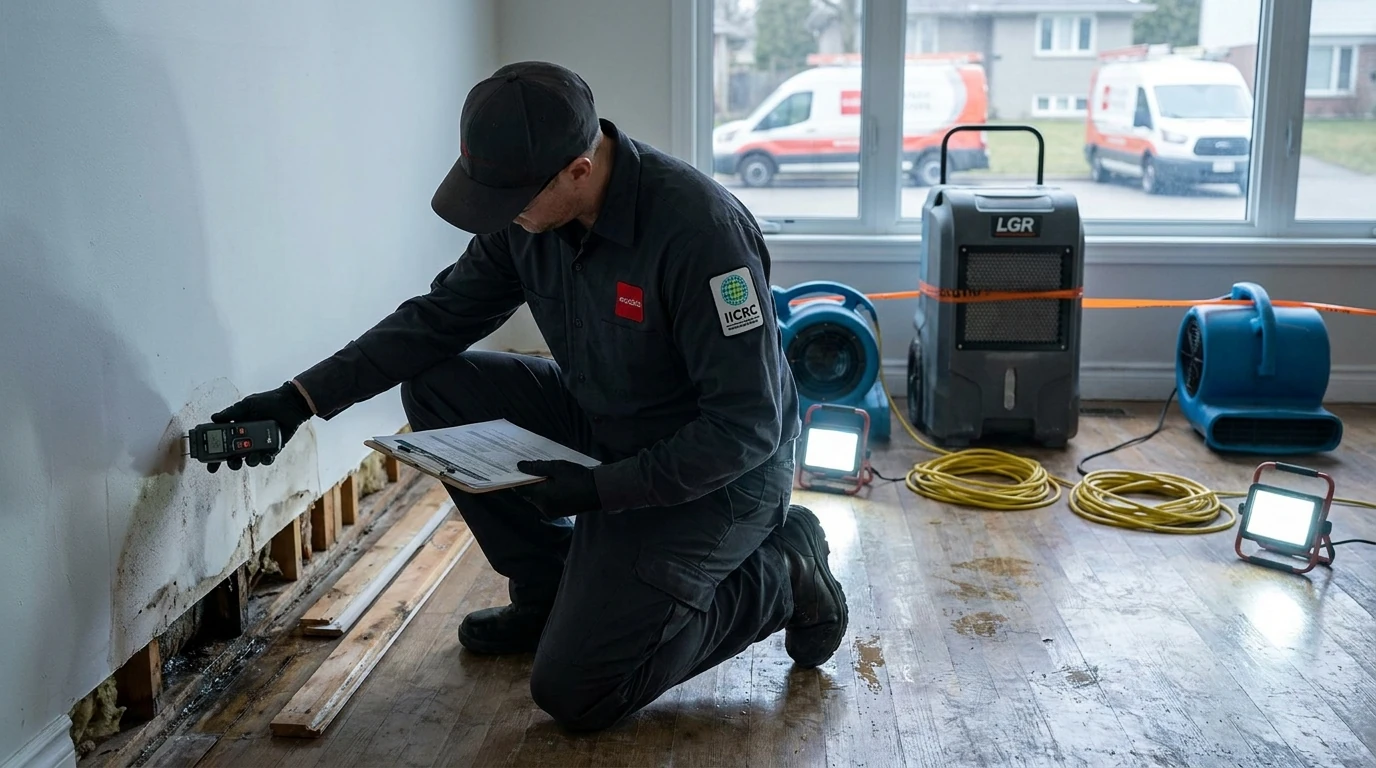
Before and during extraction, a technician uses a moisture meter and thermal imaging camera to map how far water has traveled. Water follows gravity and wicks laterally through drywall, insulation, and wood framing, the wet zone is almost always larger than the visible stain.
Phase 2: Structural drying setup (Day 1-2)
Once extraction is complete, the crew places industrial drying equipment throughout the affected area:
- LGR (Low Grain Refrigerant) dehumidifiers pull moisture out of the air as the structure releases it. These are not the same as a hardware-store dehumidifier, a single LGR unit can remove 30 to 80 pints of water per day.
- Air movers (high-velocity axial fans) create a vortex of airflow across wet surfaces, accelerating evaporation from floors, walls, and ceilings.
- Drying chambers may be built with poly sheeting to concentrate airflow in a specific wall cavity or room.
For Category 2 or 3 losses, affected drywall is typically cut out at a measured height (called a “flood cut”) to expose the wall cavity, allow it to dry, and remove contaminated material. This is not optional, drywall is a cellulose-based material that mold colonizes within 24 to 72 hours of saturation.
Phase 3: Daily moisture monitoring (Days 2-5)
A technician returns each day to take moisture readings at documented locations using a pin-type or pinless moisture meter. The goal is to reach the “drying goal”, a moisture content level established from unaffected reference materials in the same structure. Drying is not complete when the surface feels dry; it is complete when the meter readings match the reference.
This daily monitoring also produces the documentation your insurance adjuster needs: a drying log with dates, readings, and equipment placement records. Without it, claims are harder to support.
Phase 4: Equipment removal and clearance (Day 3-7)
Once moisture readings reach the drying goal across all affected areas, the equipment is removed. A final inspection confirms no elevated moisture remains in wall cavities, subfloor, or framing. If mold growth was present or the loss involved Category 3 water, an air quality test may be recommended before clearance.
Phase 5: Repairs and restoration
With the structure dry and cleared, the repair phase begins: replacing drywall, insulation, flooring, trim, and any other materials removed or damaged during mitigation. This phase can be handled by the same restoration company or a separate contractor depending on the scope. Water damage restoration and water cleanup services cover the mitigation phases; reconstruction is scoped separately.
What can go wrong if restoration is delayed or done incorrectly?
Delaying professional restoration, even by 24 to 48 hours, significantly increases both the damage and the cost. Mold can begin colonizing wet drywall and wood within 24 to 72 hours under the right temperature and humidity conditions. Category 1 water that sits becomes Category 2 as bacteria multiply. Hardwood floors that might have been saved with rapid drying often cup and buckle beyond repair if drying is delayed.
Two mistakes homeowners make that complicate the process:
-
Running residential fans and HVAC instead of professional equipment. A box fan moves air but does not remove moisture from it. Running your HVAC system can distribute contaminated air and moisture through the duct system. Industrial LGR dehumidifiers are engineered specifically to pull moisture out of the air mass, household equipment is not a substitute.
-
Skipping documentation before cleanup. Your insurance claim depends on a documented record of the damage before work begins. Photograph everything, do not discard materials before the adjuster or restoration company documents them, and keep a written timeline of when the damage occurred and what steps you took. The post Does Homeowners Insurance Cover Water Damage? walks through what policies typically cover and what documentation protects your claim.
If you are still in the first hours after discovering damage, the Burst Pipe Emergency Checklist covers the immediate steps to take before the crew arrives.
What should you do right now if your home has water damage?
If the water source is still active, stop it first: shut the supply valve at the fixture or the main shutoff for the house. Then call a certified restoration company. The faster extraction begins, the smaller the drying zone and the lower the final cost.
While you wait for the crew:
- Move valuables and electronics out of the wet area if it is safe to do so.
- Do not use electrical outlets or fixtures in the affected area.
- Take photos and video of all visible damage.
- Do not discard any damaged materials, the adjuster needs to see them.
For water losses in Ventura County and the surrounding area, California Restoration West holds IICRC certifications in Water Damage Restoration (WRT), Applied Structural Drying (ASD), and is an IICRC Certified Firm. The team is available 24/7. Call (805) 290-7292 to schedule an emergency assessment or request a written scope before work begins.
If your property is a business rather than a residence, the process has some important differences in scope and timeline, the companion post on commercial water damage restoration covers how businesses limit downtime after a loss.
About California Restoration West
California Restoration West is an IICRC Certified Firm serving Ventura, CA and surrounding Ventura County communities including Oxnard, Camarillo, Thousand Oaks, and Simi Valley. Founded in 2025, the company holds IICRC certifications in Water Damage Restoration (WRT), Applied Structural Drying (ASD), and Applied Microbial Remediation (AMRT), and is OSHA trained. Services include water damage restoration, water cleanup, mold remediation, storm damage restoration, contents restoration, and crawl space encapsulation. California Restoration West is licensed, insured, and locally owned.