When water starts spreading across a floor, the homeowner isn’t shopping for five quotes. They want one clear signal: will this person show up, communicate honestly, and finish the job right. That’s the kind of experience a customer near Ventura, CA described after a water damage call this past September.
“Jimmy provided excellent water restoration service. He was professional, responsive, and did a great job from start to finish. I really appreciate his attention to detail and customer service. Highly recommended!” , Atila, verified Google review
The technician named in that review, Jimmy, is also the person behind this breakdown: Jimmy Salsbury, a water damage technician with California Restoration West in Ventura, CA. Here’s what each part of that review actually means on a real job, and what homeowners should expect if they’re facing a similar call.
”Professional and responsive”: what that looks like on a water call
On a water loss, “responsive” means the technician can tell you what you’re dealing with and what the first hour involves before they even walk in the door. That starts with a few quick questions on the phone: where the water is coming from, whether it’s still flowing, and what it’s touched so far.
That triage matters because water damage is categorized by source. Clean water from a supply line behaves very differently than water that’s backed up through a drain or sat for days. The ANSI/IICRC S500 standard, the industry reference for water damage restoration, defines these categories and sets the drying protocols that follow from them. A responsive technician is already thinking in those terms on the drive over, not figuring it out after arrival.
“Professional” shows up in smaller ways too: arriving with the right equipment the first time, explaining what’s being done and why, and giving the homeowner a realistic picture of the timeline instead of a vague reassurance.
”Attention to detail”: the part of a water job nobody sees
Attention to detail on a water job mostly happens in the walls and under the flooring, not on the surface. A floor can look dry to the eye while the subfloor underneath is still holding moisture that will cause problems weeks later.
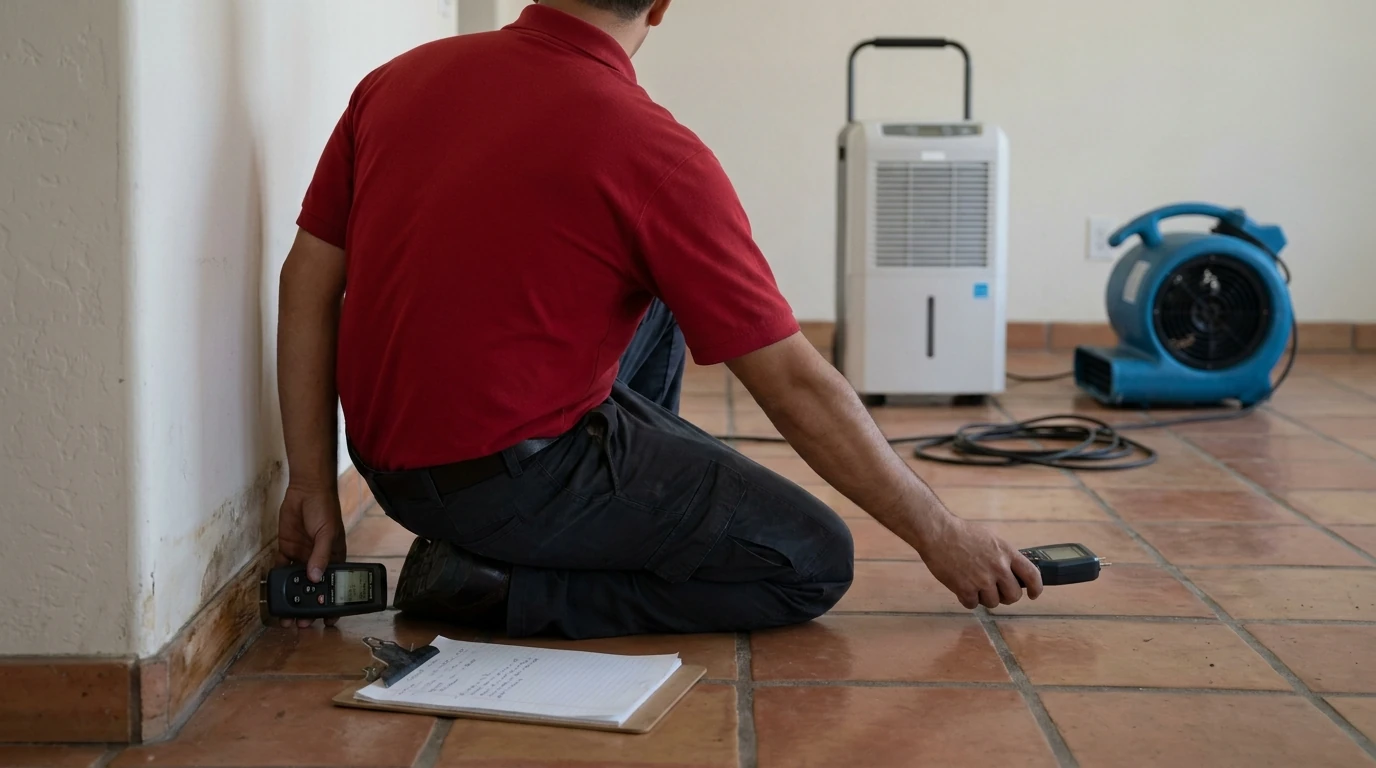
That’s why a thorough technician maps moisture with a meter at the start of the job and checks it again daily, not just once. Baseboards get pulled where needed, flooring is checked at the edges, and readings are logged so there’s a clear record of when the structure actually reached a dry standard, not just when it stopped feeling wet. That documentation also becomes useful later if the homeowner needs to show an insurer the loss was mitigated properly.
Our post on what water damage restoration actually involves goes deeper into how that drying and monitoring process works.
”Start to finish”: the actual phases of a water restoration job
A water restoration job runs through three phases: emergency mitigation, monitored drying, and any repair work the loss requires.
- Mitigation: standing water is extracted, affected materials are assessed, and anything that can’t be saved, like soaked carpet pad, is removed before it becomes a mold risk.
- Drying: air movers and dehumidifiers are placed based on the moisture map, then checked daily until the structure reads dry.
- Repair: drywall, flooring, or trim that was removed during mitigation gets rebuilt to match the original space.
A job that goes “start to finish” smoothly is one where the same technician, or a tight crew, stays on it through all three phases instead of handing the homeowner off between strangers. Our residential water damage restoration guide walks through what each of those phases looks like inside an actual home.
When does a water issue need a restoration call instead of a mop and a fan?
Call a restoration company if water has been sitting for more than a few hours, touched drywall or flooring, or came from anything other than a clean supply line. Past that point, a wet-vac and a box fan usually aren’t enough to prevent moisture from settling into materials that hold it.
If you’re dealing with a water loss in Ventura County right now, you can call California Restoration West at (805) 290-7292 for an assessment. The team is IICRC certified in water damage restoration and structural drying, and is available 24/7.
This case study is based on a real, verified Google review. Details beyond what the reviewer wrote are general information about how water restoration jobs typically run, not specifics of this particular loss.